

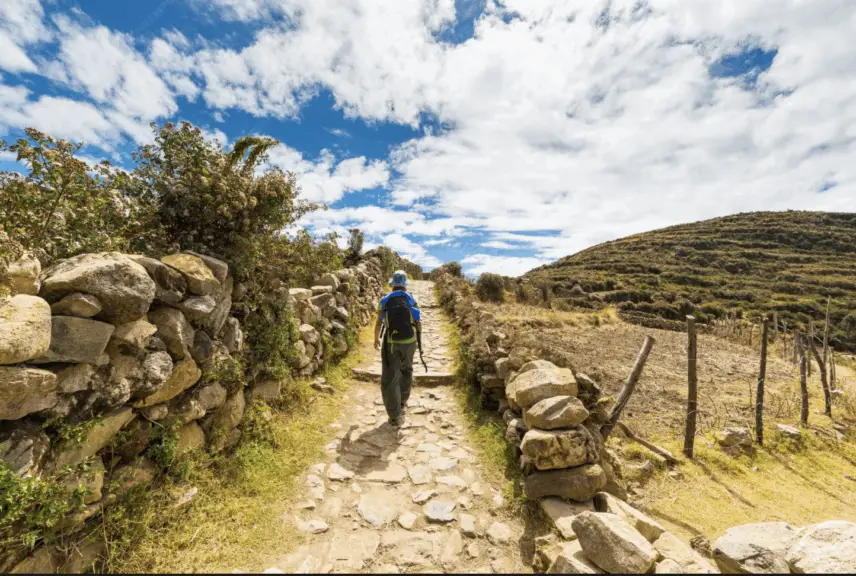
For centuries, the Camino de Santiago has been a test of faith, endurance, and willpower. However, today we are witnessing a silent, yet profound transformation in the way travelers walk its many routes. Far from exhausting 30-kilometre days and staying in overcrowded hostels, a new philosophy has emerged: the art of walking slowly.
In fact, nowadays, a pilgrim’s success is no longer measured by how quickly they reach the Plaza del Obradoiro, but by the depth of the connections they build along the way. For travelers who enjoy carefully planning each stage and truly value the landscapes they cross, the Camino is becoming a canvas for introspection and sensory enjoyment, where quiet villages and secluded paths are the true protagonists.
Redefining the Camino
As mentioned earlier, the “slow travel” trend has found its ideal setting on the Camino routes. People have come to understand that this is not an endurance race, but a cultural immersion experience where every lived moment matters. By adopting a gentle walking pace, travelers are discovering that the Portuguese Camino, in particular, offers the perfect infrastructure for this kind of journey.
In this sense, this shift in mindset is attracting a type of walker who does not seek to “survive” the Camino, but to live it with comfort and purpose, someone who understands that meticulous planning allows each stage to be adapted to their physical abilities, turning what was once a grueling physical challenge into a pleasurable itinerary full of nuance.
Why the Portuguese routes?
The Portuguese Camino, both the Central Route and the Coastal Route, is a favorite among those seeking this balance. Why? Its gentle topography, proximity to picturesque villages, and a service offering that enables seamless logistics. As you walk through Portugal and enter Galicia from the south, the scenery gradually shifts from sunlit vineyards to eucalyptus forests and Galician estuaries, offering a visual variety that can only be fully appreciated when you are not in a hurry and walk while enjoying the landscape.
The charm of picturesque villages and hidden corners
Walking at a slow pace opens a window to details that most hurried pilgrims overlook. When you choose shorter stages, you gain the luxury of time. You can stop at a small Romanesque chapel not listed in every guidebook, or spend an hour chatting with a local artisan in a stone village that seems frozen in time.
Architecture and local life
In places such as Ponte de Lima or Viana do Castelo, the journey pauses to admire Manueline architecture or ancient Roman bridges. Walking slowly allows you to observe how the afternoon light hits the granite walls of Galician villages. And it is in these moments of stillness that the true magic of the Camino unfolds: the smile of a woman tending her garden, the scent of freshly baked bread in a ten-person village, or the sound of a stream running alongside the path.
Moreover, these quiet trails are the perfect antidote to the noise of modern life, allowing you to slow down and stop being a mere observer to become part of the landscape.
Smart planning: the key to serenity
To truly enjoy this “art of walking slowly,” improvisation must be set aside. A relaxed Camino de Santiago filled with memorable experiences requires detailed planning, where the concept of a “VIP” or carefully curated itinerary makes all the difference. This does not necessarily mean ostentatious luxury, but rather the quality of logistical decisions, such as:
- Custom stages: instead of following the standard 25 km stages, the route is divided into stretches of 12 to 15 km, ensuring you arrive with enough energy to explore the village where you stop.
- Charming accommodation: rural guesthouses, Galician pazos, or exclusive hotels are selected to guarantee real rest in environments of absolute silence.
- Luggage transport: backpacks and suitcases are transferred for you, allowing you to walk with only the essentials. This frees the body, helps maintain your desired pace, protects your joints, and prevents accumulated fatigue.
Thus, those seeking an experience designed around comfort and depth make use of all available resources -such as professional logistics- to elevate their journey to a higher level of wellbeing.
Understanding this new way of doing the Camino
To help you understand how this model is changing the traveller’s experience, here are some of the most common questions from those considering a Camino without rushing:
How does slowing down change the experience of walking from village to village?
Walking at a slower pace allows travellers to observe architecture in detail, interact genuinely with locals, and enjoy landscapes in ways that faster itineraries rarely allow. Instead of seeing villages merely as places to sleep, they become destinations to discover.
What planning strategies help create a calmer Camino?
It is recommended to start early to avoid the heat, choose shorter stages that do not exceed 4–5 hours of walking, and select quiet accommodation away from noisy centres. This can completely transform the rhythm of the journey, eliminating the stress of the “race for a bed.”
Why are scenic, unhurried routes gaining popularity among modern travellers?
Because they combine nature, cultural depth, and emotional clarity. The Camino de Santiago offers a refreshing alternative to modern travel styles focused on seeing as much as possible in the shortest time, allowing space for personal reflection through slow movement.
We should not forget that walking along nature-filled paths at a steady yet gentle pace induces emotional clarity, reduces cortisol levels, and fosters creativity.
On the Camino de Santiago, this translates into mental clarity. Without the pressure of extreme physical endurance, you can devote your energy to processing thoughts, enjoying silence, or simply marvelling at the connectedness of the environment.
Practical tips for your journey
If you are ready to design your own slow route, keep these points in mind:
- Listen to your body: a gentle walking pace is one that allows you to hold a conversation without losing your breath. Do not compete with anyone.
- Invest in good footwear: even with shorter distances, quality, well-tested shoes are non-negotiable to avoid blisters that can ruin your walk.
- Choose the shoulder season: to enjoy quiet paths, consider walking in May, June, or September, when the weather is pleasant and crowds are smaller.
- Document the journey: carry a travel journal. With more free time in the afternoons, you can record those village details others forget.
As you can see, the Camino de Santiago is evolving. It has become an invitation to reclaim ownership of our time, to let the journey itself be the destination and transform into a process of inner change.
So, if you are looking for an experience that combines historical authenticity with modern comfort, remember that the most rewarding route is not always the shortest or fastest, but the one that allows you to treasure every step.
